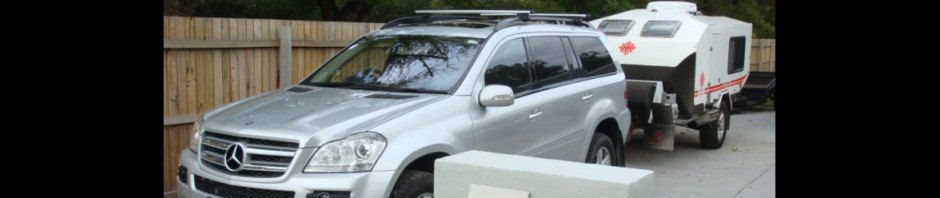
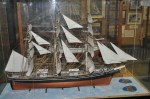
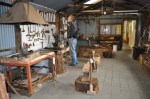
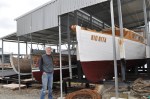
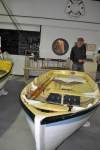
I had another look under the car & decided I needed a different type of strap so headed off to Repco before breakfast, then mucked about with it again back at the caravan park before breakfast. We got away around 10am & headed to the Axel Stenross Boat Museum. We were impressed by the quality of the museum & the variety of wooden boats, photos, boating equipment & the original Axel Stenross workshop, complete with all original tools & living quarters. The volunteers do a great job on restoration & maintenance work. They even had a restored Heavyweight Sharpie on display plus a model of the Cutty Sark, a ship my great grandfather made a journey on out to Australia from Scotland.
We left Port Lincoln heading northwards, still 12 degrees & cold in the wind, towards our next destination, Arno Bay. We passed lots of vivid green wheat fields & a few brilliant yellow canola fields, plus the odd sheep paddock extending down to the waters edge. Some of the old farmhouses were made from stone & were either in really good condition or derelict. Some great restoration projects for someone.
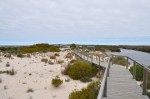
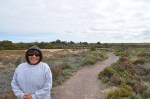
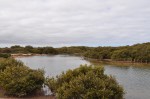
Arno Bay was reached at lunchtime so we drove to the mangrove boadwalk carpark & had lunch next to the creek using the great tables & shelter built by the Arno Bay Hotel Social Club, complete with gas BBQ. The wind was so cold Ron & I wore all our warm clothes (I wore a singlet, shirt, vest & 2 jumpers). The mangrove boardwalk is quite extensive & very well done, at the start there were warning signs regarding a territorial butcherbird. Well, he certainly was feisty, swooping us at every opportunity when our backs were turned. It’s amazing, when I turned around quickly he would stop, so I had a little game with him, turning my back, then looking at him very quickly. He would stop & perch as soon as I looked at him. He still managed to swoop Tereza once & me a couple of times, (maybe the poor thing was worried when it saw all the feathers in Ron’s hat) however, once we left his rather large territory he left us alone. The boardwalk even had resting stations & platforms built, complete with bait/fish cleaning boards, so that you could fish from them directly into the creek – fantastic. We saw a couple of nesting Pied Oyster Catchers & a whole swag of pelicans on the beach. We really enjoyed our walk.
On the road before Whyalla we came across a huge mountain that had been severely disfigured with flat tops & multi coloured tailing dumping, this was Iron Baron, an iron ore mine that supplied the Whyalla steelworks. The road from there to Whyalla was very straight, with a view of the town in the distance the downhill road didn’t waiver for 17km. The steelworks & support industries dominate the township of Whyalla, with smoke & steam belching from the chimneys. As we approached Port Augusta the Flinders Ranges formed a magical backdrop, with the low sun highlighting all of the valleys & folds in the mountains. Port Augusta is surrounded by water, it is very low lying at the head of the Spencer Gulf. I took the opportunity to refuel & kept on heading south towards Adelaide before turning off toward Sydney along the Wilmington Road & through the Horrock Pass (another historical site).
We stopped at the summit of Horrock Pass at a very large rest area next to a cairn that marks something of significance (no sign on it to tell the story). Tereza whipped up a magnificent vegetarian meal, it was delicious (tomorrow we will be crossing the border to New South Wales). A full moon was rising over the mountains as dinner was cooking & finished the day off nicely. We are on our lonesome on this very isolated beautiful rest area.





 Trekkin